How big should a rocket’s parachute be? Most online calculators make this straightforward: enter the rocket’s recovery mass, choose a descent speed, and calculate a parachute diameter.
That is a useful starting point. If you accept 6 m/s—about 20 ft/s—as a suitable landing speed, the familiar mass-based calculation gives you a parachute size under its assumed drag conditions. But it leaves an important question unanswered: why is that speed suitable for your rocket?
Jump to the Chute Calculator..
Mass sets the load. Speed changes the landing.
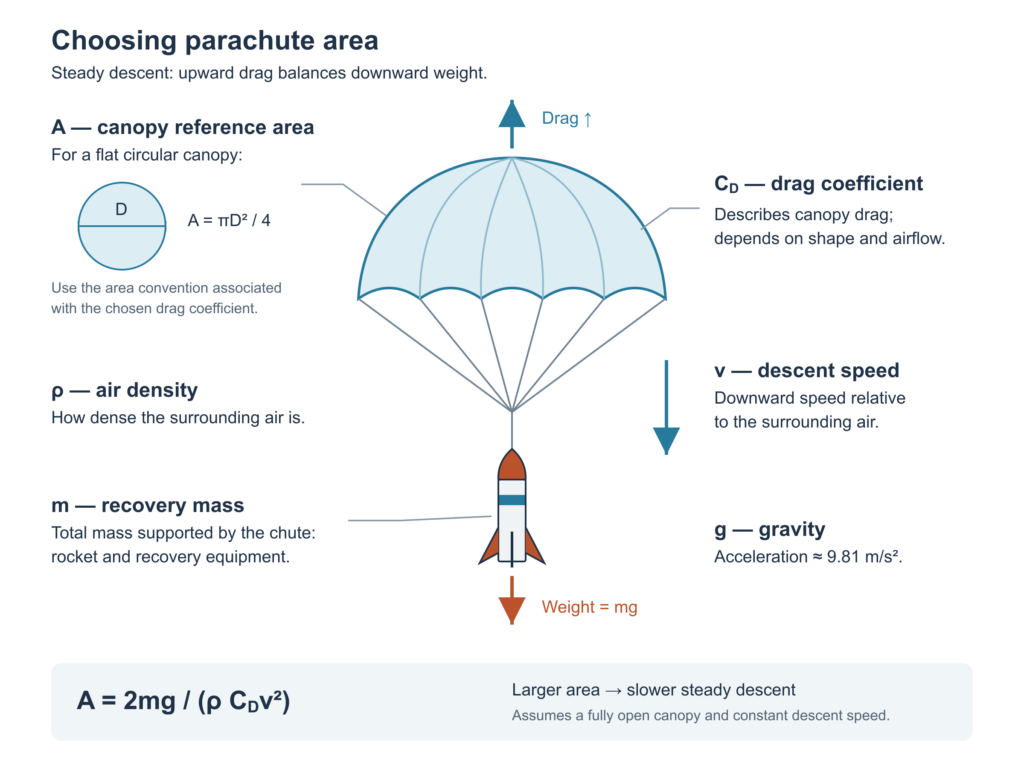
A parachute slows a rocket by producing drag. During steady descent, that drag balances the rocke’s weight. A heavier rocket needs more parachute area to maintain the same descent speed.
The usual relationship is:
\[
A=\frac{2mg}{\rho C_Dv^2}
\]
Here, (A) is parachute area, (m) is recovery mass, (g) is gravitational acceleration, ($\rho$) is air density, ($C_D$) describes the parachute’s drag, and (v) is the chosen descent speed.
Mass is usually known. The choice of speed deserves more attention: halving the descent speed requires four times the parachute area, assuming the same air density and drag coefficient. For a circular parachute, that means twice the diameter.
What happens when the rocket reaches the ground?
The rocket’s kinetic energy is:
\[
E_k=\frac12mv^2
\]
A small increase in speed can therefore make a substantial difference to the landing. The same rocket arriving at 6 m/s carries 44% more kinetic energy than it does at 5 m/s.
How abruptly that energy is removed matters too. A rocket stopping over a short distance experiences a greater average stopping force than one slowing over a longer distance. Grass, soil, the rocket’s orientation, and deformation all affect that distance. Five centimetres of grass does not necessarily provide five centimetres of cushioning.
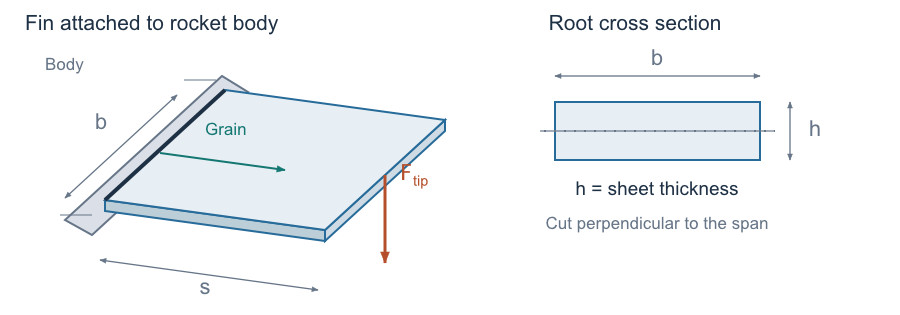
The fins also matter a lot. Their thickness, root width, span, grain direction, and attachment affect their ability to withstand a landing load. Mass alone cannot tell us whether a particular landing speed is acceptable.
A simple model to make the choice more informed
To explore this, I modeled a balsa wood fin as a small cantilever beam: fixed at the rocket body, with a force acting perpendicular to the fin at its tip.
The analysis connects three estimates:
- The bending load the fin might withstand.
- The landing speed compatible with that load over an assumed stopping distance.
- The parachute area needed to achieve that speed.
For illustrative purposes, a 195 g rocket, with a 60 mm root chord, 60 mm span, and 3 mm thick balsa fins, the model gives a candidate descent speed of approximately 3.4 m/s when using a 50 mm stopping distance and no additional load allowance. With the same drag assumptions, that corresponds to a circular parachute approximately 26 inches in diameter, compared with about 15 inches at 6 m/s.
Those numbers are an example, not a proven safe limit. The calculation assumes sound balsa wood, favorable grain alignment, a secure attachment, and a particular distribution of force. A corner strike, twisting, or a shorter stopping distance could produce a more severe result.
The model’s value is that the assumptions are visible—and we can see how changing them changes the answer.
A larger parachute has a cost
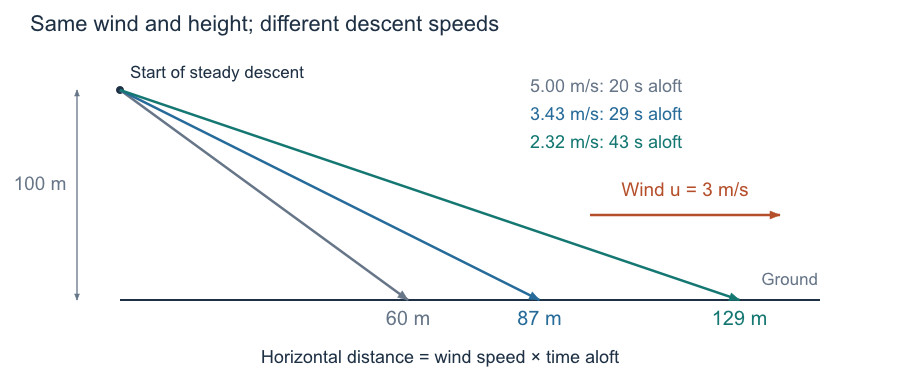
Slower descent generally reduces landing loads, but it also means more time in the air and more opportunity to drift.
In a steady 3 m/s wind, descending through 100 metres takes about 17 seconds at 6 m/s, producing roughly 50 metres of drift. At 3.4 m/s, it takes about 29 seconds, producing roughly 88 metres of drift.
A smaller parachute gets the rocket down sooner, but may land it too hard. A larger parachute softens the landing while increasing the distance you might have to walk—or the chance of your rocket leaving the recovery field and into a tree!
Choosing the Descent Velocity
A mass-based parachute calculator is useful when you already have a suitable target descent speed; OpenRocket or RockSim are super helpful in this regard. Understanding the landing helps you decide what that target should be.
The aim is to choose a speed that balances the rocket’s construction, the expected landing conditions, and the available recovery area. Even a simplified calculation can make that choice more informed, especially when followed by measured descent rates and observations from actual flights.
Before sizing the parachute, we need to estimate the landing speed the fins can tolerate. The following formula combines the fin dimensions, material bending strength, rocket recovery mass, and stopping distance to estimate a limiting descent velocity:
\[
\boxed{
v_*=
\sqrt{
\frac{2d}{m}
\left(
\frac{\sigma_{\mathrm{bend}},b,t^2}{6s}
-mg
\right)
}
}
\]
where:
- ($v_*$) — estimated limiting descent velocity (m/s)
- (d) — stopping distance during impact (m)
- (m) — total descending mass, including recovery gear (kg)
- ($\sigma_{\mathrm{bend}}$) — fin material bending strength (Pa)
- (b) — fin root chord (m)
- (t) — fin thickness (m)
- (s) — fin span (m)
- (g) — gravitational acceleration, approximately ($9.81\ \mathrm{m/s^2}$)
The term ($\sigma_{\mathrm{bend}}bt^2/(6s)$) estimates the bending load a single fin can withstand, treating it as a rectangular cantilever loaded at its tip across its thickness. The remaining expression comes from equating the rocket’s kinetic energy to the work done by the net stopping force over distance (d).
The resulting velocity can then be substituted into the parachute sizing formula. This simplified model assumes a constant stopping force and includes no safety margin, so the result represents an estimated limit rather than a guaranteed damage-free landing speed. The estimated bending load must exceed (mg) for a positive limiting velocity to exist which makes sense otherwise they couldn’t support the rocket even when sitting still on the ground.
The Interactive Parachute Sizing Calculator
Loading the parachute calculator. JavaScript must be enabled.
Want the full analysis?
Download the accompanying PDF for the beam-flexure derivation, worked examples, parachute geometry, and a closer look at the assumptions behind the estimates.