Rocket Engineering Enrichment Program

Build. Launch. Discover.

A Hands-On Rocket Engineering Experience

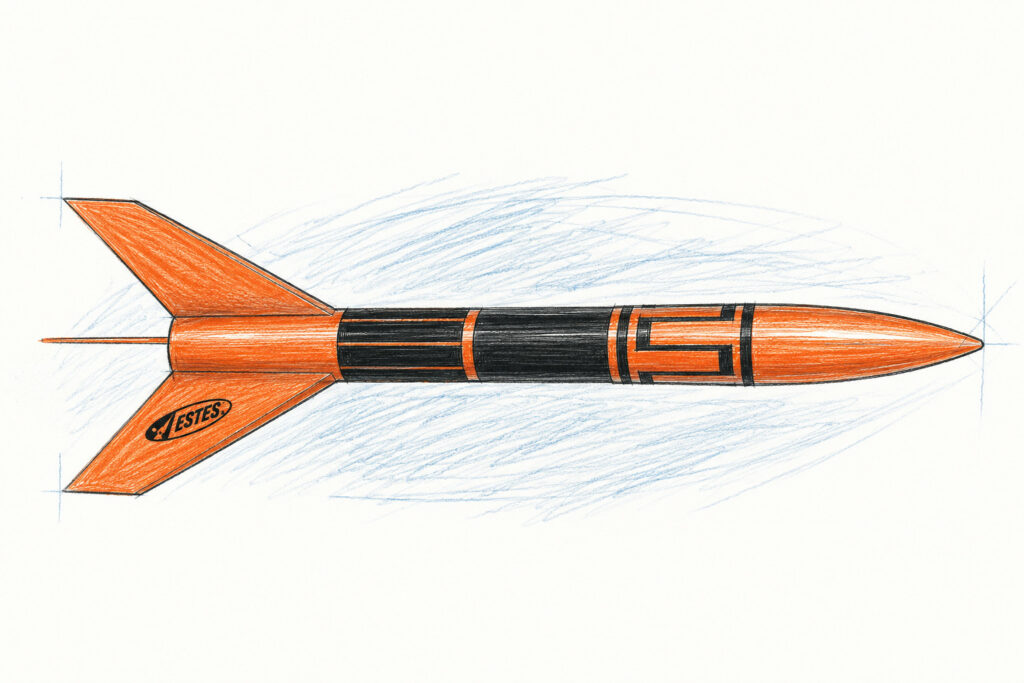
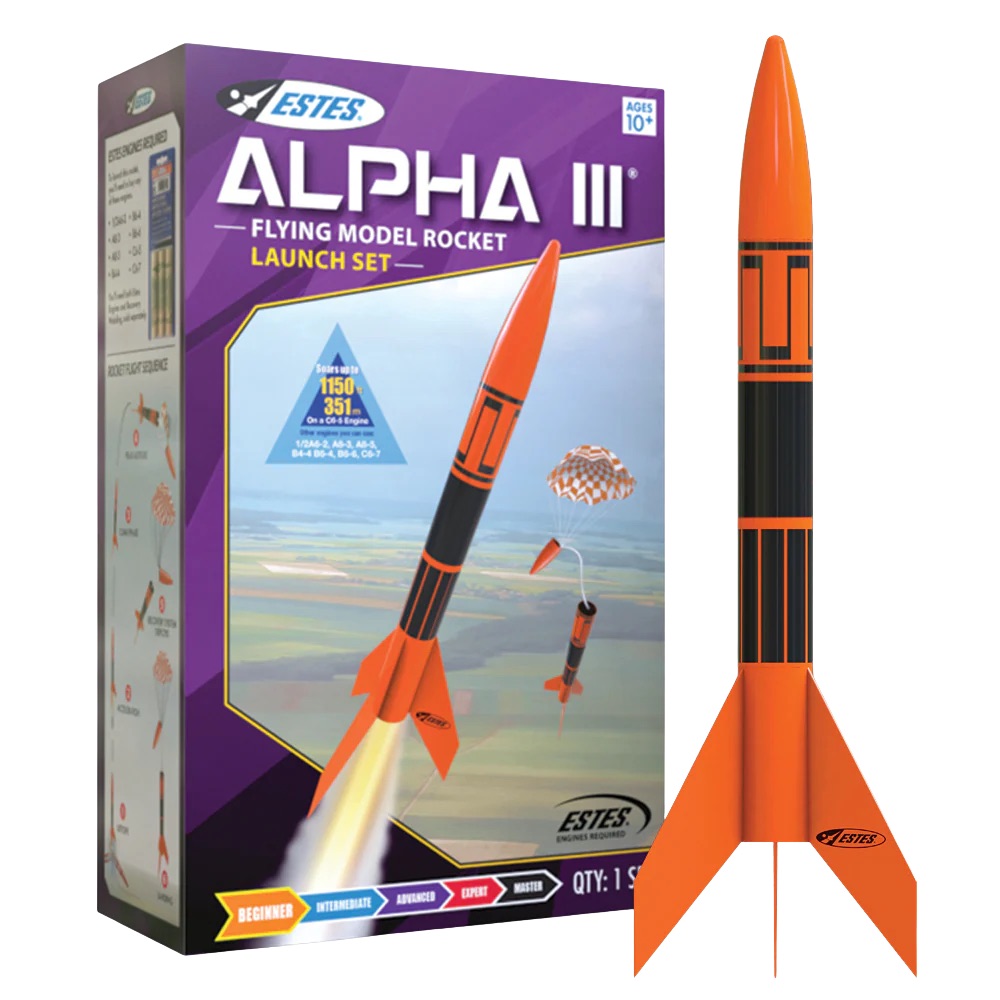
Estes Alpha III illustration

What happens when you combine engineering, physics, teamwork, and real rocket launches?

Students don’t just learn about rockets—they build one, launch it, analyze it, and discover the science that makes it fly.

This enrichment program is a project-based introduction to aerospace engineering and scientific thinking. Through a series of engaging hands-on activities, students explore how real engineers design, test, and improve rockets while developing problem-solving skills that extend far beyond the launch field.


What Students Will Do

Throughout the program students will:

  • Build and personalize their own model rocket
  • Learn how rockets generate thrust
  • Explore Newton’s Laws of Motion through demonstrations and experiments
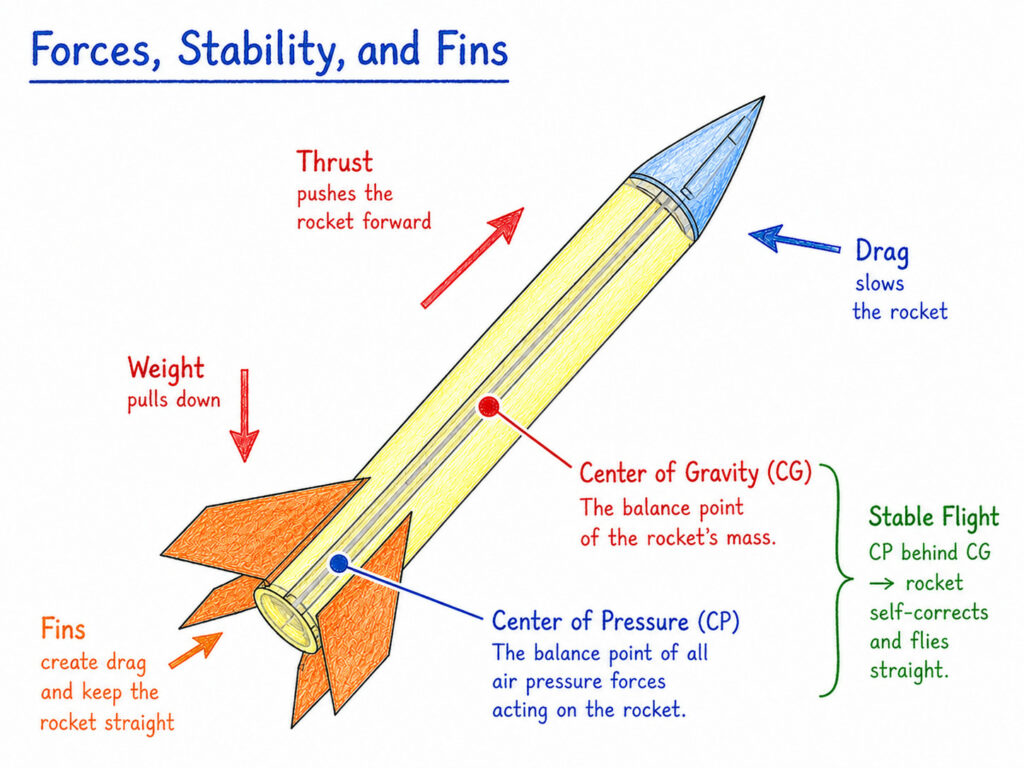
  • Discover how fins, mass, and balance affect stability
  • Measure rocket performance using real flight data
  • Practice engineering design through testing and redesign
  • Safely launch their own rocket
  • Take their completed rocket home
Build-Launch-Discover

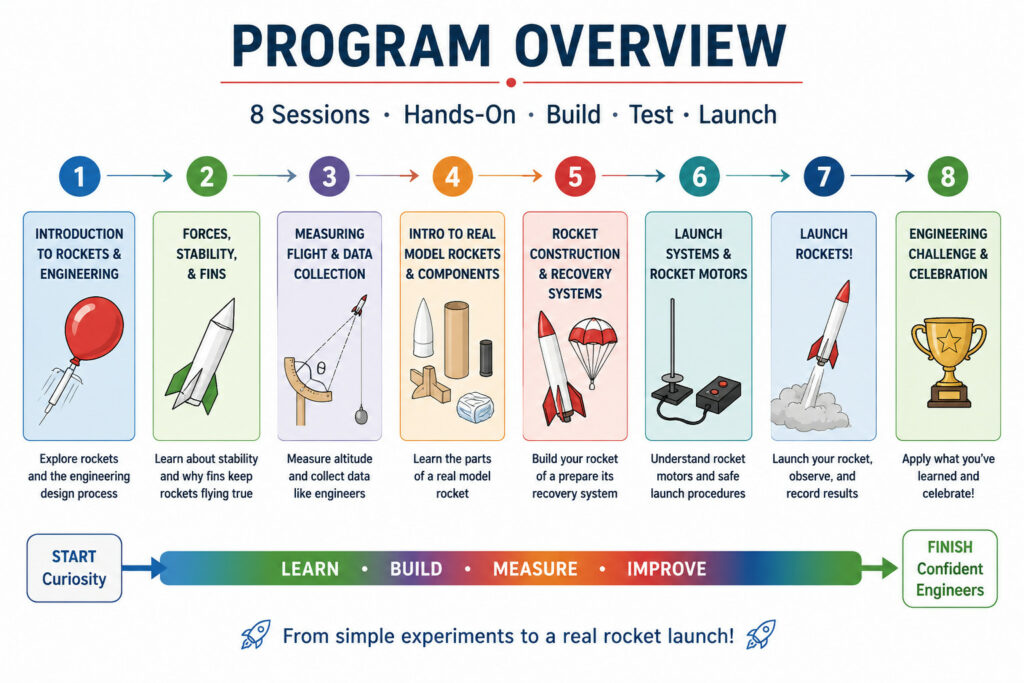
Every lesson combines a short interactive presentation with hands-on activities that keep students actively engaged.


Rocket diagram labeled

Engineering Through Experience

Students experience the ideas firsthand.

Activities include:

  • Balloon rocket experiments
  • Paper rocket design challenges
  • Rocket stability investigations
  • Model rocket construction
  • Flight prediction and analysis
  • Real launch procedures
  • Engineering design challenges

Students are encouraged to ask questions, make predictions, test ideas, and improve their designs just as engineers do.


Program Overview flowchart

Safety Comes First

Safety first poster

Model rocketry has been enjoyed safely for decades when proper procedures are followed.

Students learn:

  • Launch range safety
  • Rocket inspection procedures
  • Safe motor installation
  • Launch pad operation
  • Countdown and launch protocols
  • Recovery procedures

Safety isn’t simply discussed—it becomes part of the engineering process through structured checklists and instructor supervision.


What Makes This Program Different?

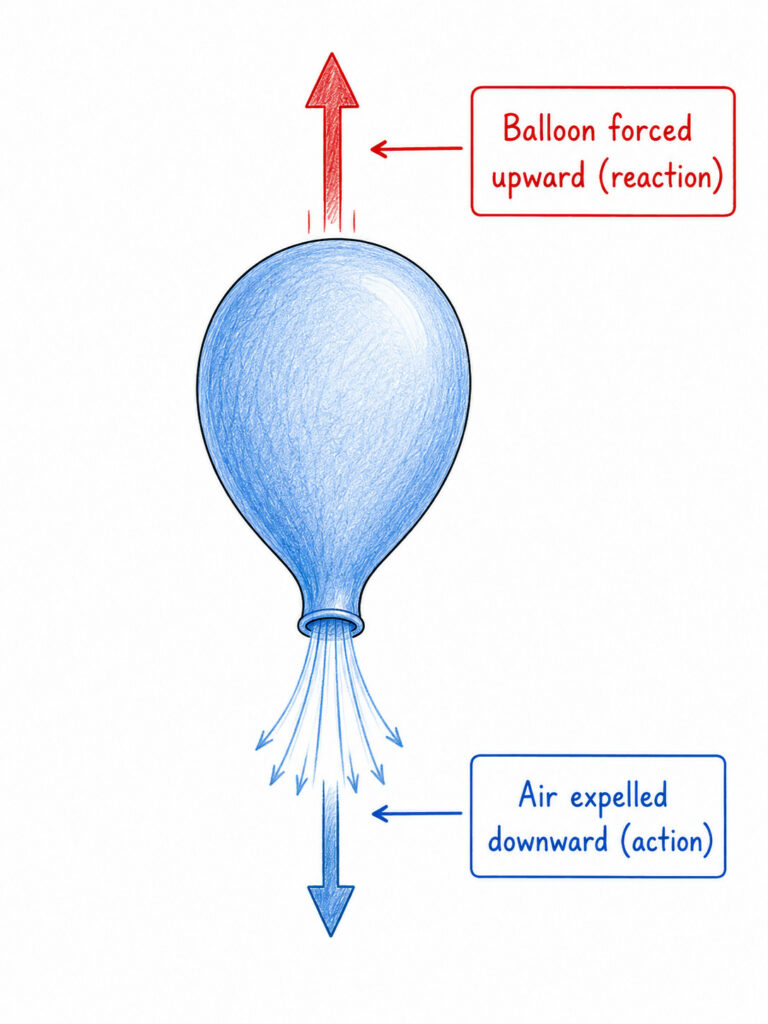
Newton's 3rd Law: Action-Reaction

Designed for curious minds. Whether a student dreams of becoming an engineer, loves building things, or simply enjoys discovering how the world works, this program provides an exciting introduction to STEM through one of the most inspiring engineering projects ever created—a flying rocket.

Every student leaves with new knowledge, greater confidence, practical engineering experience, and a rocket they built themselves. The program connects each activity into a complete engineering experience where students learn how scientific ideas explain what they observe.

Topics include:

  • Newton’s Laws of Motion
  • Thrust and propulsion
  • Aerodynamics
  • Stability and center of gravity
  • Drag and recovery systems
  • Measurement and data collection
  • Engineering design and iteration

Concepts are presented in an age-appropriate way, emphasizing curiosity and understanding rather than heavy mathematics.


Ready for Launch?

Whether your child is fascinated by space, enjoys building things, or simply loves asking “How does that work?”, this enrichment program provides an exciting opportunity to learn through doing.

Registration information, schedule, and upcoming sessions will be announced soon.

Model rocket flight sequence

The Tsiolkovsky Rocket Equation: From Conservation of Momentum to a Model Rocket

The Tsiolkovsky Rocket Equation is one of the most elegant results in classical mechanics. Despite describing everything from hobby rockets to missions leaving the Solar System, the underlying mathematics is surprisingly approachable. Starting with nothing more than conservation of momentum and a little calculus, we can derive an equation that predicts the maximum velocity change a rocket is capable of producing–often called “Delta-V”.

In this article we’ll derive the rocket equation from first principles and then apply it to a familiar model rocket—the Estes Alpha III powered by a B4-4 engine.


Why Rockets Are Different

Most vehicles push against something already present.

  • A car pushes against the road.
  • An airplane pushes against the air.
  • A boat pushes against the water.

A rocket is different because it carries its own reaction mass. High-speed exhaust gases are expelled from the nozzle, and by Newton’s Third Law the rocket is accelerated in the opposite direction.

A rocket becomes lighter as it accelerates because it is continuously throwing away part of its own mass (the fuel). That changing mass is exactly what makes rockets mathematically interesting.


Step 1 — Start with Conservation of Momentum

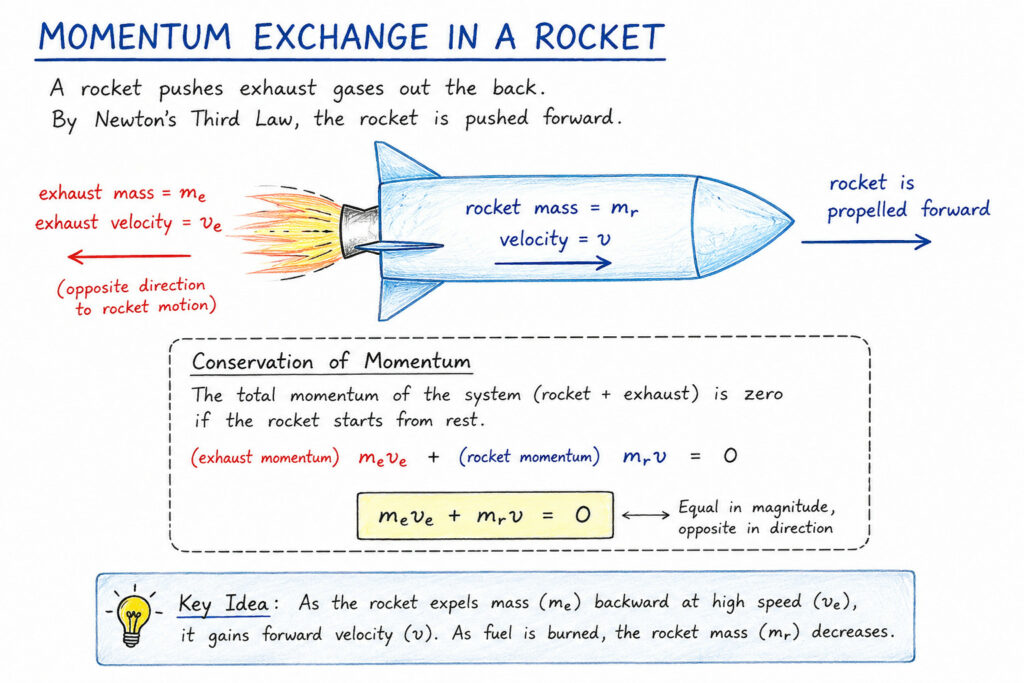
Illustration of Momentum Exchange in a Rocket

The total momentum of the rocket and the expelled exhaust must remain constant. Momentum is defined as

\[
p = mv
\]

If the rocket starts from rest, the momentum of the rocket must exactly balance the momentum carried away by the exhaust gases.

\[
m_{\text{fuel}} v_e + m_{\text{rocket}} v = 0
\]

or

\[
m_{\text{fuel}} v_e = -m_{\text{rocket}} v
\]

The negative sign simply reminds us that the rocket and exhaust travel in opposite directions.


Step 2 — Recognize that Mass is Changing

This equation is only true for an instant in time because things keep changing. As fuel burns,

  • total rocket mass decreases,
  • fuel mass decreases as it leaves the rocket as exhaust
  • rocket velocity increases.

Instead of dealing with finite changes, we examine an infinitesimally small amount of fuel leaving the rocket.

This gives

\[
dm \, v_e = – M_r \, dv
\]

where

  • \(dm\) is a tiny amount of fuel expelled,
  • \(v_e\) is the exhaust velocity
  • \(M_r\) is the instantaneous rocket mass,
  • \(dv\) is the tiny increase in rocket velocity.

Step 3 — Separate the Variables

Rearranging to solve for the rocket’s velocity \(dv\) gives

\[
\frac{v_e}{M_r} \, dm = – dv
\]

or

\[
dv = – v_e \frac{dm}{M_r}
\]

Now the rocket’s changing velocity (\(dv\)) is one side and the changing fuel mass (\(dm\)) is on the other. This form is ready for integration.


Step 4 — Integrate During the Entire Burn

Assuming the exhaust velocity remains approximately constant during the burn,

\[
\int_{v_0}^{v_f} dv =
– v_e \, \int_{M_0}^{M_f}
\frac{1}{M_r} \, dm
\]

The left side is straightforward,

\[
v_f \, – \, v_0 = \Delta v
\]

while the right side becomes the natural logarithm,

\[
-v_e \left[\ln M_f \, – \, \ln M_0\right]
\]

Using logarithm identities,

\[
\boxed{\Delta v = v_e
\ln\left(\frac{M_0}{M_f}\right)}
\]

This is the famous Tsiolkovsky Rocket Equation.


Applying the Equation to an Estes Alpha III

Now let’s see how well this ideal equation predicts the performance of a real model rocket. For this example we’ll use the specifications provided on the Estes website:

Estes Alpha III

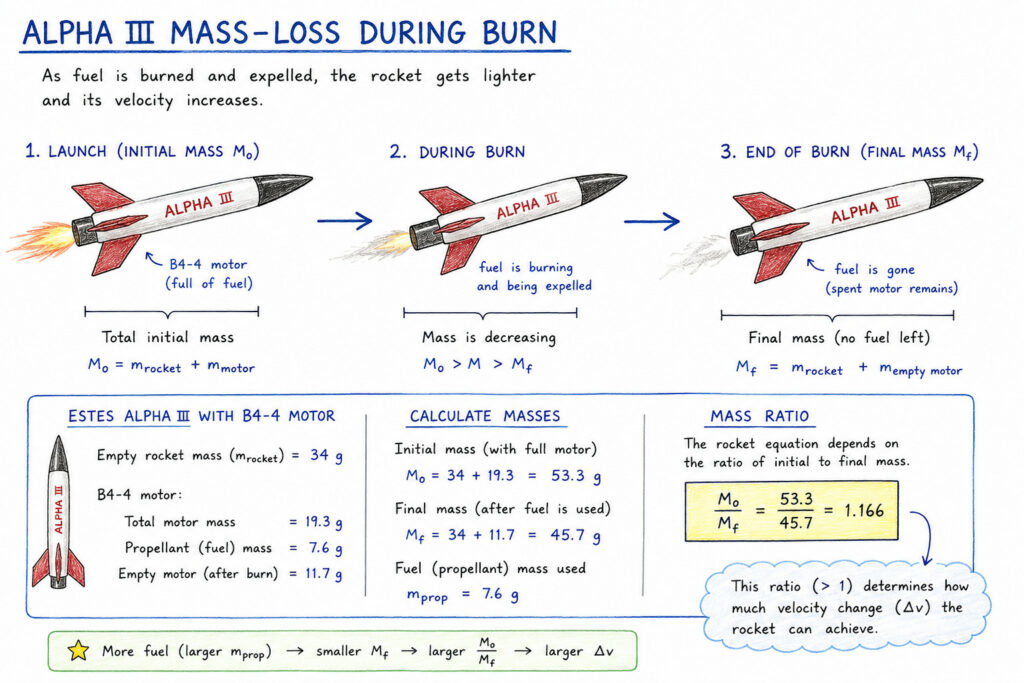
  • Empty rocket mass: 34.0 g

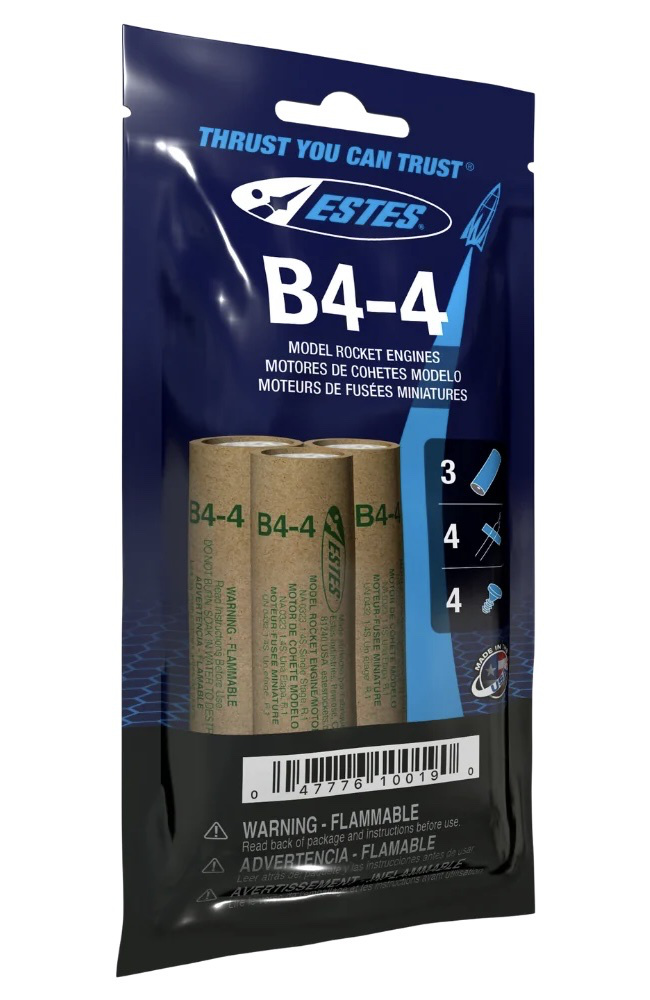
Estes B4-4 Motor

  • Motor mass: 19.3 g
  • Propellant mass: 7.6 g
  • Total impulse: 5.0 N·s
  • Burn time: 1.10 s

The rocket begins flight carrying the full motor. Therefore

\[
M_0 = 34.0 + 19.3 = 53.3\text{ g}
\]

After the propellant is burned,

\[
M_f = 53.3 \, – \, 7.6 = 45.7\text{ g}
\]

The mass ratio is therefore

\[
\frac{M_0}{M_f} = 1.166
\]

Taking the natural logarithm,

\[
\ln(1.166) = 0.154
\]

The remaining unknown is the effective exhaust velocity, \(v_e\). One estimate comes from the motor’s total impulse, which is provided in the motor’s specification sheet.

Impulse is the total push delivered by a force over time:

\[
I = F_{\text{avg}} \cdot \Delta t
\]

Impulse is also equal to a change in momentum:

\[
I = \Delta p
\]

Since momentum is

\[
p = mv
\]

the motor’s impulse can be interpreted as the momentum carried away by the expelled propellant. If the propellant mass is \(m_p\) and the effective exhaust velocity is \(v_e\), then

\[
I \approx m_p v_e
\]

This is an idealized estimate, but it gives us a useful value for the rocket equation.

For the B4-4 motor:

\[
I = 5.0 \, \text{N} \cdot \text{s}
\\
m_p = 0.0076 \, \text{kg}
\]

Solving for effective exhaust velocity:

\[
v_e = \frac{I}{m_p}
\]

\[
v_e = \frac{5.0}{0.0076}
\approx 658 \, \text{m/s}
\]

Now substitute this into the rocket equation:

\[
\boxed{\Delta v = v_e
\ln\left(\frac{M_0}{M_f}\right)}
\]

Using the previously calculated mass ratio,

\[
\ln\left(\frac{M_0}{M_f}\right) = \ln(1.166) \approx 0.154
\]

Therefore,

\[
\Delta v = (658)(0.154)
\approx 101 \, \text{m/s}
\]

The ideal rocket equation predicts a maximum velocity change of approximately

\[
\boxed{\Delta v \approx 100 \, \text{m/s}}
\]

or about

\[
\boxed{225 \, \text{mph}}
\]


Alpha III mass loss diagram

Why Doesn’t the Rocket Reach This Speed?

If you’ve ever watched an Alpha III launch, you may notice that measured peak velocities are usually lower than this calculation predicts.

That’s because the Tsiolkovsky Rocket Equation is an ideal model.

It assumes:

  • no aerodynamic drag,
  • no gravity losses during powered flight,
  • perfectly constant exhaust velocity,
  • no energy lost to heating or turbulence.

A real rocket experiences all of these effects simultaneously.

Computer flight simulators such as OpenRocket include drag, changing thrust curves, atmospheric density, gravity, and coast phase dynamics, producing much more realistic predictions.

The rocket equation, however, still serves as the fundamental theoretical limit on rocket performance.


Final Thoughts

One of the remarkable aspects of the rocket equation is that it emerges from only two ideas:

  • Newton’s Third Law
  • Conservation of Momentum

Everything else follows naturally from calculus.

Although hobby rockets are tiny compared to launch vehicles carrying satellites or astronauts, they obey exactly the same physics. Whether launching an Estes Alpha III from a school field or sending a spacecraft toward Mars, every rocket ultimately answers to the same elegant equation first derived by Konstantin Tsiolkovsky over a century ago.